Teledermatology Is Changing How Skin Lesions Get Evaluated
Store-and-forward imaging and remote triage have moved from pilot programmes into routine dermatology workflows. The research now focuses less on whether it works and more on where it fails.
From pilot to plumbing
Teledermatology has quietly become infrastructure. Store-and-forward workflows, in which a primary care clinician submits images and history for asynchronous specialist review, now handle a substantial share of lesion triage in large health systems. The question in the literature has shifted accordingly, from feasibility to accuracy, equity, and failure modes.
What the accuracy data show
Concordance studies comparing remote assessment with in-person examination generally report strong agreement for common inflammatory conditions and for clearly benign or clearly concerning pigmented lesions. Agreement narrows in the middle of the distribution, exactly where clinical judgement matters most. Image quality is the dominant variable: lighting, focus, and the presence of a dermoscopic view change diagnostic performance more than the platform used.
The access argument
The strongest case for teledermatology is not speed but reach. Waiting times for a dermatology appointment can extend for months in underserved regions, and a triage pathway that identifies urgent lesions within days reorders that queue by risk rather than by who called first. Studies in safety-net systems have documented meaningful reductions in time to biopsy for suspicious lesions.
Where it fails
Three failure modes recur. Patients without reliable smartphones or connectivity are systematically underserved by the very programmes designed to expand access. Full-body skin examination cannot be replicated remotely, so incidental lesions that an in-person visit would catch are missed. And asynchronous review removes the conversation, which is where much of the history, and much of the reassurance, actually happens.
Decision support and its supervision
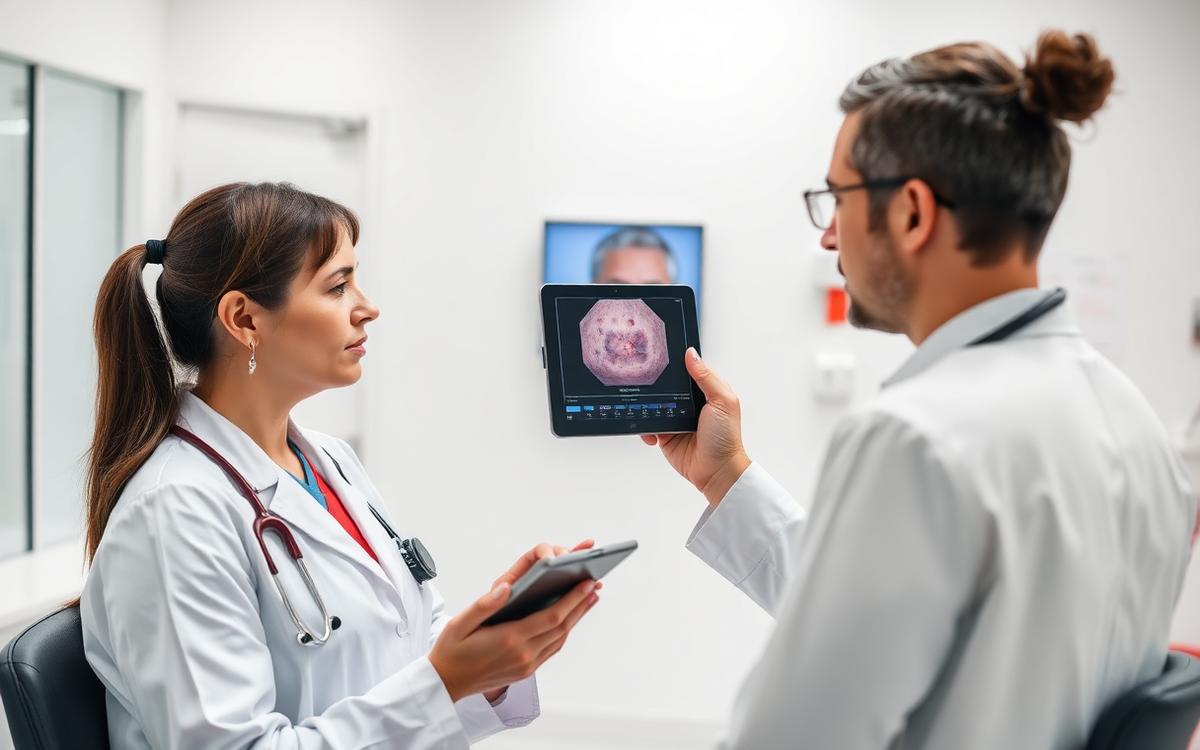
Automated lesion classification tools are increasingly embedded in these workflows. Their reported performance in curated datasets has consistently outpaced their performance in unselected clinical populations, particularly for darker skin tones, where training data have historically been sparse. The governing principle in current guidance is that such tools inform triage and do not replace the clinician who bears responsibility for the decision.
What this means for training
Trainees entering practice now will inherit these systems as a default rather than an innovation. The skill worth building is not operating the platform but knowing its boundaries: which presentations require hands and a full examination, how to counsel a patient whose images were inadequate, and how to document a remote assessment so that the next clinician understands what was and was not seen.
Sources consulted
- JAMA Dermatology
- American Telemedicine Association
- Agency for Healthcare Research and Quality